

.png)

CMB Sports News 🏈🏀⚾️⚽️🏒
- Yung Goonie
- Jun 2
- 7 min read

WESTERN CONFERENCE CHAMPIONS:
SAN ANTONIO SPURS: 🏆🎊🎊🎊
The San Antonio Spurs’ run through the Western Conference Finals against the Oklahoma City Thunder will be remembered as one of the most commanding postseason performances in recent NBA memory—a blend of tactical precision, defensive discipline, and a young core maturing in real time under the brightest possible spotlight.
What began as a highly anticipated clash between two of the Western Conference’s most dynamic rising teams quickly turned into a statement series for San Antonio. The Spurs didn’t just win—they controlled tempo, dictated matchups, and systematically dismantled every adjustment Oklahoma City attempted to make. Across six games, the gap between the two teams widened not because the Thunder collapsed, but because the Spurs executed at a near-flawless level on both ends of the floor.
A Series Built on Identity: Spurs Discipline vs Thunder Chaos
Coming into the series, the narrative centered on the explosive perimeter attack of the Oklahoma City Thunder. Powered by their fast-paced offense, switch-heavy defense, and a roster filled with versatile shot creators, the Thunder had overwhelmed opponents all postseason long. Their ability to generate points in transition and force turnovers made them one of the most feared teams in basketball.
But the San Antonio Spurs arrived with a different kind of identity—slower, more structured, and ruthlessly efficient. Where Oklahoma City thrived in chaos, San Antonio specialized in removing it. Head coach staff emphasized half-court control, defensive rebounding, and forcing the Thunder into prolonged possessions that tested their patience.
From Game 1 onward, that philosophical clash defined everything.
Game 1: Setting the Tone in San Antonio
The Spurs opened the series at home and immediately imposed their will. The first quarter alone showcased their defensive blueprint: early switching on screens, collapsing the paint, and forcing Oklahoma City into contested mid-range attempts.
By halftime, the Thunder’s transition game had been effectively neutralized. San Antonio’s guards consistently sprinted back, eliminating easy fast-break opportunities. On offense, the Spurs leaned into high-post actions and off-ball movement, stretching Oklahoma City’s defense in ways it hadn’t been challenged all postseason.
The final margin—a double-digit Spurs victory—was less important than the message: this series would not be played on Oklahoma City’s terms.
Game 2: Thunder Adjust, Spurs Respond
Oklahoma City’s coaching staff attempted to counter with increased pace and early shot-clock threes. For stretches, it worked. The Thunder built a small third-quarter lead behind a barrage of perimeter scoring and aggressive drives.
But San Antonio’s response was decisive. They shifted into a double-big lineup that controlled the glass and slowed the tempo further. Every Thunder run was met with a counterpunch: a drawn charge, a defensive rotation forcing a shot-clock violation, or a long offensive possession ending in a high-percentage look.
The Spurs stole Game 2 on the road, a pivotal moment that swung home-court pressure heavily in their favor.
Game 3: The Defensive Masterpiece
Game 3 will likely be studied for years by defensive coaches.
San Antonio held Oklahoma City to one of its lowest scoring outputs of the season. The Spurs’ switching scheme was near perfect—every screen was neutralized, every drive funneled into help defenders, every kick-out met with a closeout.
The Thunder’s star guard line struggled to find rhythm as the Spurs consistently forced them into late-clock isolation situations. Even when Oklahoma City managed to break through, San Antonio’s rim protection erased clean looks at the basket.
Offensively, the Spurs didn’t need fireworks. They simply capitalized on mistakes, turned defensive stops into efficient half-court execution, and ground the game into their preferred style.
Game 4: The Thunder Fight Back
Facing a 3–0 deficit in the series, Oklahoma City responded with urgency. Game 4 was their most complete performance—fast breaks returned, three-point shooting stabilized, and defensive pressure created turnovers that fueled momentum.
For the first time in the series, San Antonio looked uncomfortable. The Spurs’ young rotation showed brief lapses in communication, and Oklahoma City exploited them to secure a much-needed win.
But even in defeat, the Spurs revealed their resilience. They didn’t abandon their system. They didn’t panic. They simply absorbed the punch and prepared for the next adjustment.
Game 5: The Turning Point
Back in San Antonio, Game 5 became the defining moment of the series.
The Thunder opened aggressively, determined to extend the series. But midway through the second quarter, the Spurs delivered a decisive 18–2 run that flipped the game entirely. It was built not on shooting variance, but on structure: defensive stops, rebounding control, and surgical execution in transition.
San Antonio’s bench unit proved especially critical, extending possessions, forcing turnovers, and maintaining defensive intensity when starters rested.
By the fourth quarter, the Thunder were visibly worn down. Their pace had slowed, their shot selection tightened, and their defensive rotations began to lag just half a step behind.
Game 6: The Championship Close
The closeout game was a showcase of composure.
Oklahoma City came out desperate, hitting early shots and attempting to speed the game into a track meet. But San Antonio refused to deviate. Every possession was deliberate. Every defensive rotation was disciplined. Every rebound was secured with authority.
Midway through the third quarter, the Spurs delivered the final blow—a stretch of suffocating defense that produced multiple empty Thunder possessions and converted them into efficient scores on the other end.
The final minutes became a celebration in motion as San Antonio’s bench emptied and the home crowd roared in recognition of a team that had executed its vision to perfection.
The Bigger Picture: A New Western Power Emerges
This Western Conference Finals victory signals more than just a championship berth for San Antonio. It represents the arrival of a new identity in the modern NBA: a team built not solely on star power or pace, but on cohesion, discipline, and adaptable execution.
The Thunder, despite their loss, remain one of the league’s brightest young contenders. Their athleticism, shot creation, and defensive versatility will keep them in the title conversation for years to come. But against San Antonio, they encountered a team that removed the oxygen from their style of play.
For the Spurs, this series becomes a defining milestone—a proof of concept that their system can withstand elite offensive pressure and still prevail at the highest level.
And as the franchise moves forward into the NBA Finals, one thing is clear: the Spurs are no longer just developing. They are dominating.

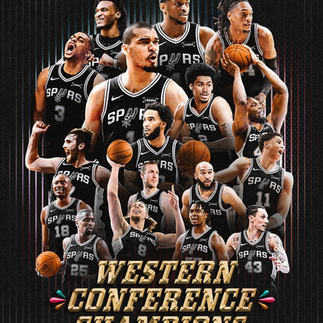
Victor Wembanyama Caps the Run With a Historic MVP Season:


As if the San Antonio Spurs’ Western Conference Finals domination over the Oklahoma City Thunder wasn’t enough to signal a shifting power balance in the league, the postseason narrative reached its peak with Victor Wembanyama being crowned league MVP—cementing one of the most remarkable breakout seasons in modern NBA history.
At just 21 years old, Victor Wembanyama didn’t merely meet expectations—he completely redefined them.
A Season That Redefined “Sophomore Leap”
From opening night, Wembanyama was no longer treated as a developmental project. He became the structural foundation of everything San Antonio did.
His impact stretched far beyond traditional box score production. He altered shot selection league-wide, anchored one of the NBA’s most efficient defenses, and forced opposing teams to redesign entire offensive game plans just to avoid his presence in the paint.
By midseason, MVP conversations that once centered around established superstars had shifted toward a question no one fully anticipated answering so soon: how high was Wembanyama’s ceiling in Year 2?
The answer came in overwhelming fashion.
Statistical Dominance Meets Defensive Gravity
Wembanyama’s MVP campaign was defined by a rare combination of volume and efficiency. He averaged elite scoring numbers while maintaining top-tier efficiency from all three levels. But what truly separated him from the field was his defensive influence.
Opponents routinely shot significantly worse at the rim when Wembanyama was the primary defender. Even plays he didn’t directly contest were affected by his positioning—drivers altered angles, perimeter players rushed floaters, and entire offensive sets shifted away from the paint.
He became the rare player who didn’t just defend possessions—he erased options before they even developed.
The Spurs Built Everything Around Him—and It Worked
The Spurs’ system under Wembanyama was a masterclass in maximizing a generational defensive anchor. San Antonio’s defensive scheme was built like a funnel: force penetration, collapse the floor, and rely on Wembanyama to eliminate high-percentage finishes at the rim.
Offensively, the Spurs embraced a modern, positionless structure that allowed Wembanyama to operate both as a primary scorer and a high-post facilitator. His ability to initiate offense from the elbow added a layer of unpredictability that most teams simply could not match.
By the time the playoffs arrived, the Spurs weren’t just a well-coached team—they were a perfectly calibrated system built around a player who bent the geometry of the game itself.
The MVP Vote: A Landslide Finish
When the MVP results were announced, there was little suspense.
Wembanyama secured the award in dominant fashion, receiving overwhelming first-place votes and finishing far ahead of veteran stars who had defined the league for years. The voting reflected not just statistical excellence, but transformative impact—Wembanyama didn’t just perform better than everyone else; he changed how basketball was played.
A Playoff Run That Sealed the Legacy
His MVP trophy wasn’t just a regular-season award—it was validated in real time during the Spurs’ playoff run.
Against the Thunder in the Western Conference Finals, Wembanyama elevated his game even further. His rim protection reached historic levels, and his offensive consistency under pressure silenced any remaining doubt about his readiness for superstardom.
Game after game, Oklahoma City found itself adjusting entire possessions around his presence. What had once been promising offensive sets turned into perimeter resets and contested jump shots. The Thunder didn’t just lose matchups—they lost options.
The Beginning of a New Era in San Antonio
With the Spurs advancing to the NBA Finals and Wembanyama crowned MVP, San Antonio suddenly finds itself at the center of the league’s future.
What began as a rebuild has accelerated into a full-scale championship trajectory. The Spurs now possess not only one of the most dominant young cores in the league but also the singular talent around whom an entire generation of basketball may be defined.
For the rest of the NBA, the message is unmistakable:
The Spurs are no longer coming.
They have arrived—and Victor Wembanyama is already the best player in basketball.
Comments